Laced With Memory: The Gen Z Asian Americans Turning Sneakers Into Wearable Family Heirlooms
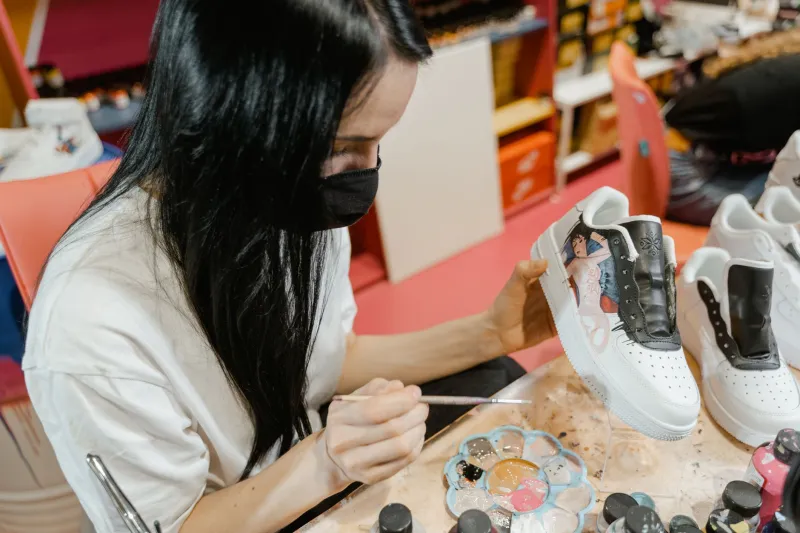
There's a pair of Air Force 1s sitting on a shelf in a bedroom in San Jose that most people will never get to see in person. The toe box is hand-painted with a lotus pond scene lifted straight from a framed photograph that used to hang in a grandmother's living room in Hà Nội. The heel tab is stamped with a family surname in chữ Nôm script. The lace dubraes? Tiny oxidized bronze charms shaped like fish — the same kind that dangled from a bracelet the owner's mom wore on her wedding day.
They're not for sale. They're not even really for wearing. They're a story.
"My grandma passed and I didn't know how to process it," says Minh, 22, who spent three weeks painting the shoes between college finals. "I didn't want to write something. I wanted to make something she could've touched."
This is what sneaker culture looks like when it collides with the Asian diaspora experience — and it's happening all over the country, in bedrooms and basement studios, at swap meets and Discord servers, quietly and furiously.
Beyond the Hype Beast Era
For a long time, the sneaker world had a very specific image: mostly Black and Latino kids in major cities, Supreme drops, StockX resale margins, clout measured in how fast you could cop a limited release. Asian Americans were absolutely part of that scene — but often on the margins, or performing someone else's cultural script.
What's shifted in the last few years is a generation of young Asian Americans deciding they want to bring their aesthetics into the conversation. Not as a gimmick. Not as a collab with a brand that slaps a cherry blossom on a midsole and calls it a day. But as something genuinely personal, sometimes private, often political.
Jasmine, a 24-year-old Filipino American designer based in LA, started customizing sneakers during the pandemic. She'd been doing graphic design work for brands but felt creatively suffocated. "Everything was so sanitized," she says. "I wanted to make something ugly and beautiful at the same time — the way my lola's house looked, you know? Plastic on the couches, saints on every wall, a karaoke machine in the corner."
Her first custom pair featured the archangel Michael rendered in the style of a Philippine pabalat wrapper, surrounded by sampaguita flowers. She posted it on Instagram expecting maybe her cousins to react. Instead, it went mini-viral in Filipino American creative circles and she had 40 DMs by morning.
The Motifs Are the Message
What makes this subculture distinct isn't just the aesthetics — it's the intentionality. These aren't kids slapping random "Asian" imagery on a Nike because it looks cool. There's research happening. Family photo albums are being dug out of closets. Grandparents are being called and actually listened to.
Derrick, 21, a Hmong American from Minneapolis, spent months learning traditional paj ntaub (flower cloth) patterns from his aunt before he felt ready to incorporate them into his designs. "Those patterns mean things," he says. "They're not decoration. They're communication. I had to understand what I was saying before I put it on something."
His work now incorporates geometric paj ntaub motifs alongside references to the Hmong refugee experience — a map of the Mekong River on one shoe, a silhouette of a refugee camp on the other. It's heavy subject matter for a sneaker. That's kind of the point.
"People see shoes and they let their guard down," Derrick says. "Then they ask about the design and suddenly we're having a real conversation about history they never learned in school."
Community as Collector's Market
This isn't purely an art project, either. There's a real economy forming around it — small, community-driven, deliberately kept out of mainstream resale platforms by many participants.
Swap meets and pop-up markets in cities like Houston, Seattle, and the Bay Area have started featuring Asian American sneaker artists alongside food vendors and vintage sellers. Discord communities with names like Kicks & Kinship and Sole Heritage have hundreds of members trading customs, commissioning pieces, and sharing technique tutorials.
Prices vary wildly. Some artists charge a few hundred dollars for a custom pair. Others trade goods and services within tight community circles, keeping the work intentionally off the commercial grid. A few have caught the attention of larger brands — and most have turned down or heavily negotiated those offers.
"A brand wanted to do a collab and they kept calling my work 'Asian-inspired,'" says Jasmine. "I was like, it's not inspired by anything. It is something. There's a difference."
That distinction matters enormously to this community. The fear of dilution — of having deeply personal cultural imagery flattened into trend-cycle content — is real and frequently discussed.
When the Shoe Becomes an Archive
Maybe the most radical thing about this movement is how it reframes what a sneaker even is. In mainstream hype culture, value is determined by scarcity and brand prestige. Here, value is determined by story density — how much history, how much family, how much specificity you can pack into a size 10.
Some collectors are building what amount to wearable archives: series of shoes that document family migration, generational trauma, cultural survival. One Bay Area artist is working on a 12-pair project that traces his Chinese American family's history from Guangdong province through the Gold Rush era to the present day. Each shoe corresponds to a decade. Each design pulls from a different family document — a letter, a photograph, a naturalization certificate.
"My family doesn't really talk about this stuff," he says. "But I can show them a shoe. That opens a door."
That's the quiet genius of what's happening here. Sneakers are a language that crosses generational lines in Asian American families in a way that, say, a podcast or an essay might not. A 70-year-old immigrant grandparent might not engage with a think piece about diaspora identity. But they might pick up a shoe, turn it over in their hands, and say: where did you learn this pattern?
And then, maybe, a story gets told that never would have been otherwise.
Sole Food
There's something very Cổ Kính Ánh Hồng about all of this — this idea that the old and the new aren't opposites, that ancient symbols and hypebeast culture can coexist in the same object, that heritage isn't a museum piece but a living thing you can lace up and take outside.
These kids aren't rejecting their Americanness. They're not performing some idealized, untouched cultural purity either. They're doing what every generation of immigrants and their children has always done: taking what they inherited and making it into something that fits the life they're actually living.
Just, you know, with a heat gun and some acrylic paint.
And honestly? The results are gorgeous.