Mirror, Mirror on the 'For You' Page: How Asian-American Teens Are Rewriting Beauty on Their Own Terms
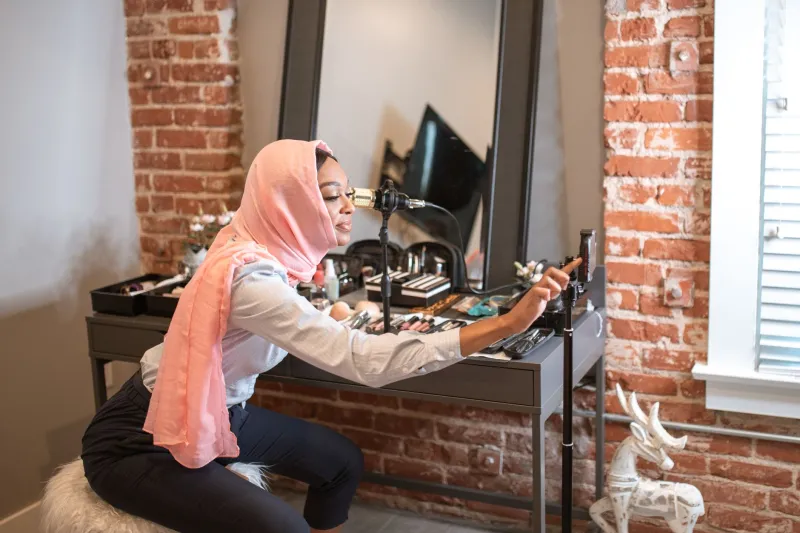
There's a video that keeps circulating in certain corners of TikTok. A Vietnamese-American teenager sits in front of her ring light, no filter, no editing, and traces her finger along the soft fold — or lack of one — above her eye. "This is a monolid," she says, calm and matter-of-fact. "And it's not a flaw. It's literally just my face."
The comment section explodes. Thousands of replies from Filipino, Korean, Chinese, Cambodian, and Indian-American teens, many of them saying some version of the same thing: I never heard anyone say that out loud before.
That moment — small, unsponsored, filmed in a bedroom — captures something much bigger that's been quietly building across Asian-American communities. A generation that grew up watching their features get erased, edited, or exoticized is now using the same phones and platforms that once made them feel invisible to do something radical: show up exactly as they are.
What the Previous Generation Inherited
To understand why this matters so much, you have to understand what came before it.
For decades, the dominant beauty messaging absorbed by Asian-American kids was essentially Eurocentric with an Asian filter slapped on top. Double eyelid surgery was normalized — in some families, openly gifted as a graduation present. Skin-lightening creams lined bathroom shelves without much conversation about why. Girls with rounder faces, broader noses, or deeper complexions absorbed the message that these were problems to manage, not features to appreciate.
"My mom used to tell me to stay out of the sun," says one 22-year-old Filipina-American creator based in the Bay Area who posts under the handle @dalaga.diaries. "Not for sunscreen reasons — for skin tone reasons. That was just... normal. Nobody questioned it."
The beauty industry didn't help. For years, Asian-American consumers were either ignored entirely or marketed to through a lens of aspirational whiteness — lighter, sharper, smaller. Even K-beauty, which exploded into mainstream American consciousness in the early 2010s, often arrived stripped of its cultural complexity and repackaged as a universal "glass skin" ideal that still centered a very specific, very narrow look.
The TikTok Turning Point
Something shifted around 2020. Partly it was pandemic boredom turning teens into creators. Partly it was the racial reckoning happening across American culture. And partly it was just the math of the algorithm — when enough people create content celebrating the same thing, the platform amplifies it, and suddenly a kid in suburban Houston sees someone who looks like her going viral for existing.
Creators like Bretman Rock, Tiffany Yu, and a wave of lesser-known but fiercely followed micro-influencers started making beauty content that didn't apologize for Asian features — it centered them. Tutorials designed specifically for hooded or monolid eyes. Shade recommendations for medium-to-deep South and Southeast Asian skin tones that major brands had long ignored. "Get ready with me" videos where the point wasn't transformation — it was presence.
"I started my channel because I couldn't find anyone showing me how to do eyeliner with my actual eyes," says a 19-year-old Korean-American creator from Atlanta who posts beauty content to her 87,000 Instagram followers. "Every tutorial assumed you had a crease. I was just constantly trying to adapt advice that wasn't made for me."
Her tutorials now get saved by the tens of thousands. Her DMs, she says, are full of messages from younger teens — many of them twelve, thirteen, fourteen — who found her before they found any other beauty content that reflected them.
The Liberation and the Trap
Here's where it gets complicated, because this is Cổ Kính Ánh Hồng and we don't do easy answers.
The same platforms creating space for this celebration of Asian features are also, by their nature, platforms built on engagement, aspiration, and the quiet pressure to perform. For every creator posting an unfiltered selfie, there are thousands of ads for serums, tools, and routines. For every "you're beautiful as you are" comment, there's an algorithm that rewards a very specific kind of photogenic.
Dr. Linda Nguyen, a clinical psychologist in Los Angeles who works extensively with Asian-American adolescents, has seen both sides of this in her practice. "What I'm hearing from my younger patients is genuinely more positive self-talk around their features than I heard five years ago," she says. "They have language for things like colorism and Eurocentric beauty standards. They can name what was done to previous generations. That's real progress."
But, she's quick to add, the pressure hasn't disappeared — it's just migrated. "Now instead of 'look more Western,' the message is sometimes 'look more like this specific kind of beautiful Asian girl who's going viral.' It's still a narrow target. It's still someone else's standard."
There's also the exhausting labor of representation itself. Many young Asian-American creators describe feeling responsible for their communities in ways their white peers simply don't. Every video becomes a statement. Every comment about their skin or their eyes carries extra weight. "I can't just post a makeup look," one creator told us. "I'm always also posting a political position, whether I want to be or not."
Body Diversity and the Conversation Nobody Wants to Have
If the monolid conversation has gained real traction, the body diversity piece is still catching up — and it's messier.
Asian-American communities carry their own complicated relationship with body image, one that intersects with diet culture, intergenerational commentary (the infamous "you got fat" greeting from a relative), and the persistent stereotype that all Asians are naturally small. Creators who don't fit that mold — whether they're plus-size, muscular, tall, or simply built differently than the K-pop aesthetic suggests — are starting to push back, but they're doing it against both mainstream American fatphobia and intra-community pressures.
"It's a double layer," says one Hmong-American creator from Minneapolis who makes content about body neutrality. "White America has its thing. But then your own family has its own thing. And sometimes you're fighting both at the same time in the same comment section."
What Comes After the Glow-Up
The most interesting thing about this generation isn't the content they're making — it's the intention behind it. These creators aren't just chasing virality. Many of them are explicitly thinking about the younger kids watching, the ones who are where they were five years ago, absorbing messages about what their faces are allowed to be.
That sense of responsibility is, in its own way, a form of cultural inheritance. The elders who preserved recipes, languages, and traditions did it for the generation coming after them. These teens are doing something similar — preserving a sense of self-worth, passing it forward in sixty-second videos filmed in bedrooms and bathrooms across America.
It's imperfect. It's platform-dependent and algorithm-vulnerable and sometimes it reproduces the very hierarchies it claims to dismantle. But it's also real, and it's reaching kids who need it.
The girl with the monolid and the ring light is still posting. Her comment section is still full of teenagers saying I never heard anyone say that out loud before.
Somebody has to keep saying it.