Digging Through the Past: Why Young Asian Americans Are Finding Their Roots at the Thrift Store
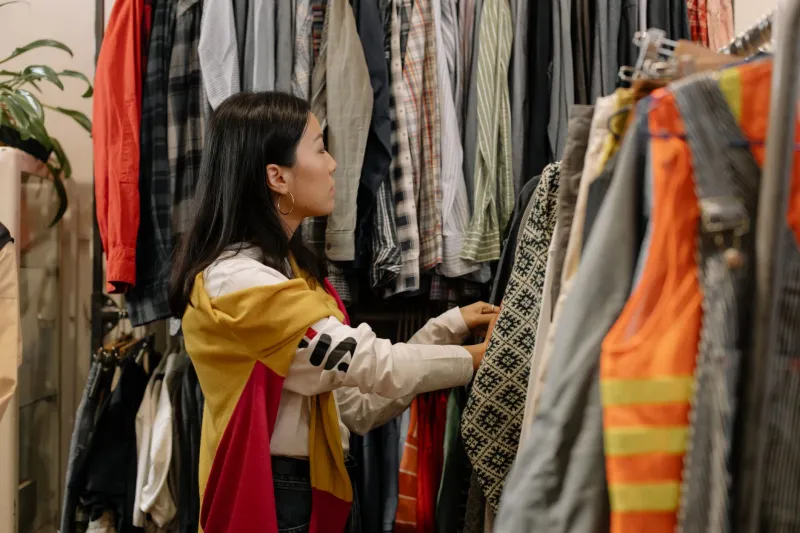
There's a particular kind of magic that happens when Linh Tran — a 26-year-old graphic designer based in Houston — spots a pale yellow áo dài hanging between a '90s windbreaker and a floral muumuu at her local Goodwill. She photographs it immediately. She texts her mom. She buys it for $4.99.
"It feels like finding something that was always supposed to be mine," she says. "Like the universe put it there."
Linh isn't alone. Across the country, young Asian Americans are showing up to estate sales, flea markets, consignment shops, and online thrift platforms like Depop and ThredUp with a very specific mission: recovering pieces of their ancestral cultures one garment, one ceramic bowl, one embroidered tablecloth at a time. What started as a scrappy, budget-conscious habit has evolved into something with real emotional and cultural weight — a grassroots reclamation project happening one secondhand score at a time.
The Problem With "Ethnic" Retail
For a long time, the options for Asian Americans who wanted to incorporate traditional clothing or home goods into their daily lives were pretty limited. You could buy new, often mass-produced pieces from import shops that felt more like tourist traps than genuine cultural touchstones. Or you could wait for a family trip back to the homeland — if that was even an option.
The commercialized "ethnic boutique" experience has always carried a particular kind of discomfort. Everything is labeled, categorized, and packaged for consumption in a way that can feel flattening. A Vietnamese silk scarf becomes a souvenir. A Korean pojagi patchwork cloth becomes a trendy wall hanging. The cultural context gets stripped away in the transaction.
Thrifting sidesteps all of that. When you find a hand-embroidered Chinese cheongsam at an estate sale in Pasadena, it arrives without a retail narrative. It came from someone's life. It has texture, wear, history. That ambiguity is actually the point.
"There's no middleman telling me what my culture is supposed to look like," says Marcus Nguyen, a 29-year-old reseller in the Bay Area who runs a small Instagram shop called @goldthread.vintage, specializing in Southeast Asian textiles. "When I find something, I get to do my own research. I get to reach out to aunties and elders and figure out what region it's from, what occasion it was made for. That process is the connection."
Sustainability Meets Ancestral Style
It's worth noting that the thrift revival doesn't exist in a vacuum. Gen Z in particular has been vocal about fast fashion's environmental and ethical costs, and that consciousness shapes how they shop across the board. Choosing secondhand isn't just financially smart — for many, it's a values statement.
But for Asian American thrifters, sustainability and cultural identity are deeply intertwined in a way that doesn't always get acknowledged in mainstream "ethical fashion" conversations.
Traditional Asian garments were, by design, meant to last. The silk ao dais made in Vietnam, the hand-stitched Korean hanboks, the intricately woven Indian dupattas — these were investment pieces, cared for across generations. Finding them in thrift stores is, in a sense, honoring that original intention. You're extending the life of something that was built to be passed down.
"My grandmother would have never thrown away a good piece of fabric," says Priya Kapoor, a 24-year-old student in Chicago who collects vintage Indian textiles. "She repaired things, she repurposed things. The idea that I'm doing the same thing — just through a thrift store instead of a family trunk — feels right to me."
Building Community Around the Find
One of the most quietly radical things about this movement is how communal it's become. Online spaces have emerged specifically around Asian American vintage collecting, where people share finds, ask for identification help, and swap styling tips.
TikTok has been a significant catalyst. Creators posting "thrift haul" videos featuring traditional Asian garments regularly rack up hundreds of thousands of views, with comment sections that function like living cultural archives — older viewers chiming in to identify regional embroidery styles, explain the significance of certain colors, or share memories of wearing similar pieces decades ago.
Marcus from @goldthread.vintage says the DMs he gets after posting a new find are some of the most meaningful interactions he has online. "I'll post a batik wrap skirt and someone's grandmother in Malaysia will comment that she made one just like it for her wedding. That's not something I expected when I started this. It turned into this intergenerational conversation."
Offline, informal swap meets and pop-up markets centered on Asian heritage goods are starting to pop up in cities with large diaspora communities — Los Angeles, New York, Houston, Seattle. These aren't just shopping events. They're social spaces where identity gets negotiated, celebrated, and passed around like a good piece of fabric.
Not Without Complications
It would be too easy to frame this whole movement as purely wholesome. There are real tensions worth sitting with.
The thrift ecosystem has been disrupted by resellers who buy low and flip high, which has driven up prices at secondhand stores and made it harder for lower-income shoppers — including many first-generation immigrants — to access affordable goods. When a vintage kimono that a Japanese American grandmother donated to Goodwill gets marked up to $200 on Depop, something complicated is happening.
There's also the question of who gets to reclaim what. Asian American identity is not monolithic, and the pan-Asian aesthetic that sometimes emerges in these spaces can accidentally flatten the very specificity these collectors are trying to honor. A Korean American styling a Vietnamese áo dài as a fashion statement occupies different territory than a Vietnamese American wearing one as a personal cultural act.
Linh thinks about this a lot. "I try to be really intentional," she says. "If I find something that's not from my own culture, I either try to get it back to someone from that community or I do serious research before I say anything about it publicly. It's not about collecting aesthetics. It's about respecting that these objects carry someone's story."
The Rack as Archive
At its best, this thrift revival is doing something that neither fast fashion nor heritage tourism can quite replicate: it's creating living, breathing archives of Asian material culture, maintained by the community itself, distributed across kitchen tables and Instagram grids and pop-up tables in church parking lots.
Every áo dài rescued from a donation bin, every silk obi found between forgotten blazers, every hand-painted rice bowl pulled from an estate sale box — each one is a small act of preservation. A small refusal to let things disappear.
For a generation that often grew up caught between cultures, told to assimilate or to perform their heritage on demand, there's something deeply grounding about holding a piece of cloth that connects you to people and places you may never fully know. You can wear that connection. You can hang it on your wall. You can pass it on.
The thrift store, it turns out, is one of the few places left where heritage doesn't come with a price tag attached to someone else's idea of what it should mean.