Lost in Translation, Found in the Middle: The Unspoken Weight of Being Your Family's Bridge to America
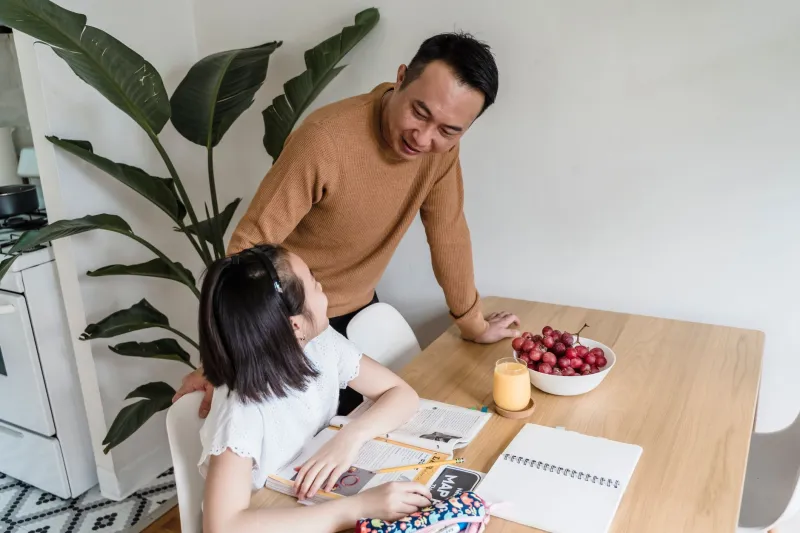
There's a scene a lot of us know by heart. You're maybe ten years old, sitting at a kitchen table covered in official-looking papers — a lease renewal, an insurance form, a letter from the IRS — and your parents are looking at you like you have all the answers. You don't, obviously. But you take a breath, squint at the fine print, and do your best anyway.
That moment — quiet, ordinary, kind of terrifying — is where so many second-generation Asian Americans first understood what they were going to be in this family. Not just a kid. A bridge.
More Than Words
When people talk about immigrant children acting as translators, they usually mean language. And yeah, that's real — navigating a parent-teacher conference in two languages at age nine will do something to your sense of self. But the translation work that shapes us most runs a lot deeper than vocabulary.
It's explaining to your mom why your boss expects you to "push back" in meetings, and that no, that's not disrespectful here. It's helping your dad understand why his new doctor is asking about his mental health, and why that question is actually okay to answer honestly. It's sitting across from a financial advisor and quietly rephrasing their jargon into something that doesn't make your parents feel like outsiders in their own lives.
Maya Nguyen, a 28-year-old social worker in Houston, puts it plainly: "I've been my parents' translator since I was a kid. But it wasn't until I was in my twenties that I realized I was also translating their dreams — like, helping them figure out what they actually wanted from this country versus what they thought they were supposed to want."
That distinction matters. A lot.
The Weight Nobody Names
There's a particular kind of exhaustion that comes with this role, and it doesn't show up in any job description. Researchers have started calling it "language brokering burden," but that clinical label barely scratches the surface. What we're really talking about is the emotional labor of holding two worldviews simultaneously — and being responsible for making them make sense to each other.
For many second-gen kids, that labor starts early and never really stops. You learn to code-switch not just linguistically but philosophically. You understand, before you have words for it, that your parents' value system — built on collective sacrifice, filial duty, and a specific vision of success — exists in real tension with the individualism, boundary-setting, and self-actualization language that American culture hands you.
And you're the one who has to live in that tension. Every single day.
Jasmine Park, a 31-year-old UX designer in the Bay Area whose parents immigrated from South Korea, describes it as "being fluent in two emotional dialects that don't have direct translations." She laughs a little when she says it, but there's something tired underneath. "My parents sacrificed everything for me to have choices. But they also have very specific ideas about which choices I should make. Being the bridge means I'm always kind of... negotiating a peace treaty."
When the Bridge Becomes the Builder
Here's the thing nobody talks about enough: there's also real power in this position. Being the family's cultural intermediary isn't just labor — it's leverage, knowledge, and in many cases, a kind of authority that reshapes the family dynamic in ways that are genuinely interesting.
Second-gen Asian Americans are increasingly the ones making major financial decisions for their families — researching retirement accounts, vetting health insurance plans, navigating the American legal system. They're the ones who know how to file for benefits, how to negotiate a salary, how to advocate in a hospital room. That's not nothing. That's enormous.
For many, it also becomes a source of unexpected career direction. An unusually high number of second-generation Asian Americans end up in social work, healthcare, law, financial advising, or community organizing — fields where the exact skills they developed at that kitchen table become professional superpowers.
"I became a nurse partly because I spent so much of my childhood translating for my parents at doctor's appointments," says Linh Tran, a 34-year-old in Chicago whose family came from Vietnam. "I already knew how to talk to scared people in a clinical environment. I'd been doing it since I was eight."
The Identity Tax
But let's not romanticize this too quickly. The pressure to be the family's bridge can come at a serious cost to the person carrying it.
Therapists who work with Asian-American clients often point to a pattern: the child who was always the competent one, the translator, the explainer, can struggle enormously with asking for help themselves. When you've spent your whole life being the person who figures things out, admitting you're lost feels almost physically impossible.
There's also the identity question. When you spend years translating yourself for your parents and your parents for the world, it can get genuinely hard to locate where you actually stand. Whose dreams are you living? Whose definitions of success are you using? The bridge, it turns out, doesn't always get to choose its own destination.
This is part of why conversations about intergenerational trauma and immigrant family dynamics have exploded in Asian-American spaces online — from Reddit threads to TikTok to the comment sections of essays that go unexpectedly viral. People are hungry to name what they've been carrying.
Rewriting the Role
What's shifting now — and this feels genuinely new — is that a growing number of millennial and Gen Z Asian Americans are actively renegotiating the terms of this role. They're not abandoning their families or rejecting their heritage. They're just deciding that being a bridge doesn't have to mean being a doormat, and that honoring your parents' sacrifices doesn't require erasing your own needs.
That looks different for everyone. For some, it's setting limits on the kind of emotional labor they take on. For others, it's having honest conversations with their parents about what they actually want from their lives — conversations that are uncomfortable and necessary and, often, surprisingly possible.
For others still, it's finding community with people who get it without explanation. The shorthand of shared experience. The relief of not having to translate yourself.
"There's something really healing about being in a room — or a group chat — with other people who just know," Maya says. "You don't have to explain the guilt or the pride or the weird power dynamics. Everyone's already fluent."
The View from the Middle
Being the family bridge is complicated. It always has been. It's a role built on love and obligation and quiet competence, and it shapes you in ways you're still discovering well into adulthood.
But it's also, increasingly, a source of identity rather than just a burden. The second-generation experience — living between worlds, translating constantly, holding contradictions without collapsing — produces people with a particular kind of emotional intelligence and cultural range that's genuinely rare.
The old country and the new one. Your parents' dreams and your own. The language you grew up speaking at home and the one you learned to survive outside it.
You didn't choose to be the bridge. But a lot of us are learning, slowly, to own what that's made us.