Under Open Skies: The Grassroots Film Nights Where Asian-American Communities Are Owning the Night
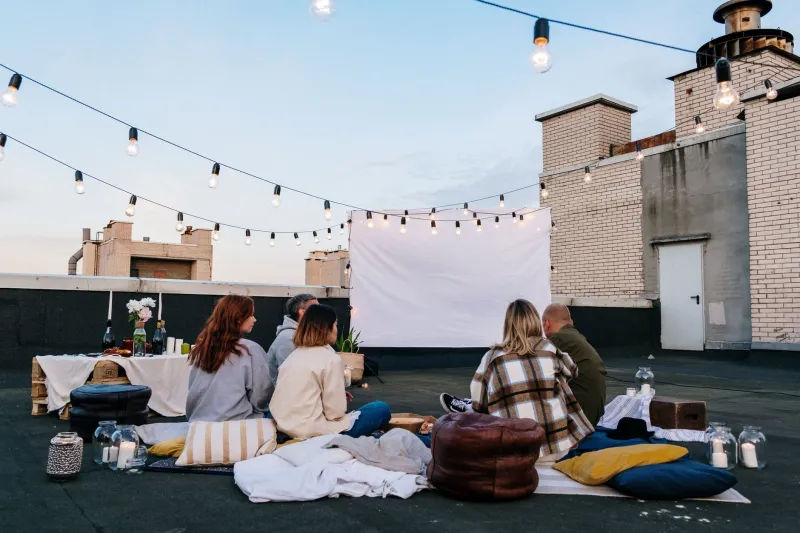
There's a particular kind of magic that happens when a film flickers to life on a makeshift screen while the city hums quietly below. Now imagine that film is in Cantonese. Or Tagalog. Or Vietnamese. And the crowd gathered on that rooftop — blankets spread, dumplings passed around in takeout containers — looks like a family reunion that didn't require a flight home. That's not a fantasy. That's what's been quietly building in cities like Los Angeles, Houston, New York, and Chicago over the last few years.
Asian-American community organizers are reclaiming public space one outdoor screening at a time, and the movement is gaining serious momentum.
More Than Just a Movie Night
Let's be honest — rooftop cinema sounds like a bougie weekend activity. The kind of thing that costs $45, comes with a branded blanket, and plays The Notebook for the hundredth time. But that's not what's happening here.
The screenings popping up in Asian-American neighborhoods across the US are intentionally low-barrier and community-first. Free or donation-based entry, food vendors from local Asian-owned restaurants, programming curated to reflect actual diaspora experiences. These aren't events designed to be aesthetic backdrops for Instagram. They're designed to make people feel like they belong somewhere.
Organizers consistently describe the same origin story: they were tired of having to explain themselves. Tired of watching Asian films only show up in niche festival sidebars or streaming algorithm rabbit holes. Tired of gathering spaces that didn't reflect their communities. So they built their own.
"The first time we screened a Taiwanese New Wave film on a rooftop in Koreatown, people cried," one Los Angeles-based organizer shared. "Not because the film was sad — though it was beautiful — but because they'd never seen something like that projected big, with their people around them. It felt like being seen in public for the first time."
The Programming Is the Point
What separates these events from your typical outdoor cinema series isn't just the vibe — it's the intentionality behind what gets shown. Organizers are doing real curatorial work, pulling from Hong Kong cinema's golden era, contemporary Korean independent film, Filipino horror, South Asian arthouse, and Southeast Asian documentaries that rarely make it to mainstream American screens.
The goal isn't to be a film school. It's to create entry points. A second-generation Vietnamese-American who grew up watching Hollywood blockbusters might show up for the social scene and leave having discovered Trần Anh Hùng. A college student whose parents immigrated from the Philippines might sit through a classic Lino Brocka film and suddenly understand something about their family that a hundred dinner conversations never unlocked.
That's the quiet power of cinema in a communal setting. It bypasses the defenses people put up around cultural identity and just... lands.
Some groups are also programming more recent diaspora-made films — short films by Asian-American directors, documentaries about immigrant neighborhoods, experimental work that doesn't fit neatly into any genre box. It's a way of honoring the continuum: this is where we came from, and this is where we're going.
Reclaiming Space as a Political Act
There's something worth naming plainly here. Asian Americans taking up public space — loudly, visibly, joyfully — is not a neutral act. Especially in the wake of the violence and hostility that surged against Asian communities in recent years, gathering openly and saying we are here, we are staying, and we're going to watch a movie about it carries real weight.
Public space in America has always been contested. Who gets to be comfortable in a park, on a rooftop, in a plaza — that's never been a purely logistical question. These film nights are staking a claim. They're saying that Asian-American culture isn't something to be experienced privately, in living rooms and ethnic enclaves, invisible to the broader city. It's something worth projecting on a twenty-foot screen.
Organizers in New York have talked about choosing their locations deliberately — rooftops in neighborhoods that are rapidly gentrifying, spaces where longtime Asian immigrant communities are being pushed out. Screening a Chinatown documentary in a neighborhood that's being slowly hollowed out isn't subtle. It's not meant to be.
The Food, the People, the Ritual
Ask anyone who's been to one of these events what they remember most, and they'll probably mention the food before the film. That's not a knock on the programming — it's a testament to how holistically these events are designed.
Vendors are almost always local and Asian-owned. You might find hand-rolled Vietnamese spring rolls next to Korean corn dogs next to mango sticky rice from a Thai dessert pop-up. The eating is communal, the way it's meant to be. People share without being asked. Strangers become tablemates.
This is where the Cổ Kính Ánh Hồng spirit lives — in the overlap between the old and the new, the heritage carried forward into a distinctly modern American context. A grandmother's recipe served under the city sky while a film plays that her grandchildren finally feel proud to call their own.
The ritual of gathering, eating, and watching together is ancient. These organizers are just finding new containers for it.
What Comes Next
The movement is still largely grassroots, which is both its strength and its limitation. Most events run on shoestring budgets, volunteer labor, and the kind of stubborn idealism that keeps people showing up even when the projector breaks or it rains.
But there are signs of growth. Some collectives are starting to partner with local arts councils and cultural organizations for small grants. A few have developed enough of a following to attract sponsorships from Asian-owned businesses looking to invest in community visibility rather than just advertising reach. Others are building programming archives, creating resources for other organizers who want to start their own series.
The dream, for many, is a sustainable infrastructure — not corporate, not co-opted, but resourced enough to keep the lights on and the screens up. A network of outdoor spaces across the country where Asian-American communities can gather, watch, eat, argue about the film afterward, and feel at home in a city that doesn't always make that easy.
For now, though, the rooftop is enough. The film rolls, the city glows below, someone passes you a piece of mochi, and for a couple of hours, everything that usually feels fragmented — the hyphen in Asian-American, the distance between who you are here and who you are at home — goes quiet.
That's worth showing up for. Every single time.